Team, roles and who sees what
The five roles, what each can do, and how access is enforced at the database rather than in the interface.
Updated 2 September 2026
There are two levels of membership. People belong to your company, and separately they are put on the projects they work. Company membership decides what kind of person they are; project membership decides which jobs they can see.
Company roles
| Role | Can do |
|---|---|
| Owner | Everything, including the plan, the branding and transferring ownership. One per company. |
| Admin | Everything operational: create projects, invite people, change roles below their own. |
| Employee | Work on the projects they are added to. No company settings. |
| Subcontractor | The same, scoped tighter — see below. |
Clients are not company members at all. They exist only on the project they were invited to.
Project roles
| Role | Programme | Diary | Photos | Documents | Snags | Financials |
|---|---|---|---|---|---|---|
| Builder | Edit | Read + write | Read + write | All | All | Yes |
| Employee | Edit | Read + write | Read + write | All | All | No |
| Subcontractor | Their tasks | Read + write | Read + write | Project documents | Assigned + report | No |
| Client | Read, shared only | Never | Read | Marked visible only | Raise + confirm | No |
The site diary is never visible to clients
Not hidden, not filtered — refused at the database. Hours, costs, subcontractor problems and your own notes about the job stay inside your company.
How this is enforced
Every table in BuildFlow has Row Level Security on it. Who can read or change a row is a rule the database applies to every query — including queries that do not come through our interface.
This matters more than it sounds. An application that hides a button is one bug away from leaking; a database that refuses the row is not. It is also why FlowAI is safe to give change tools: it runs every lookup and every write on your own session, so it inherits exactly your access and no more.
Inviting people
Company settings → Team issues a link or QR code that adds somebody to the company with the role you choose. They sign up once and are then available to add to any project.
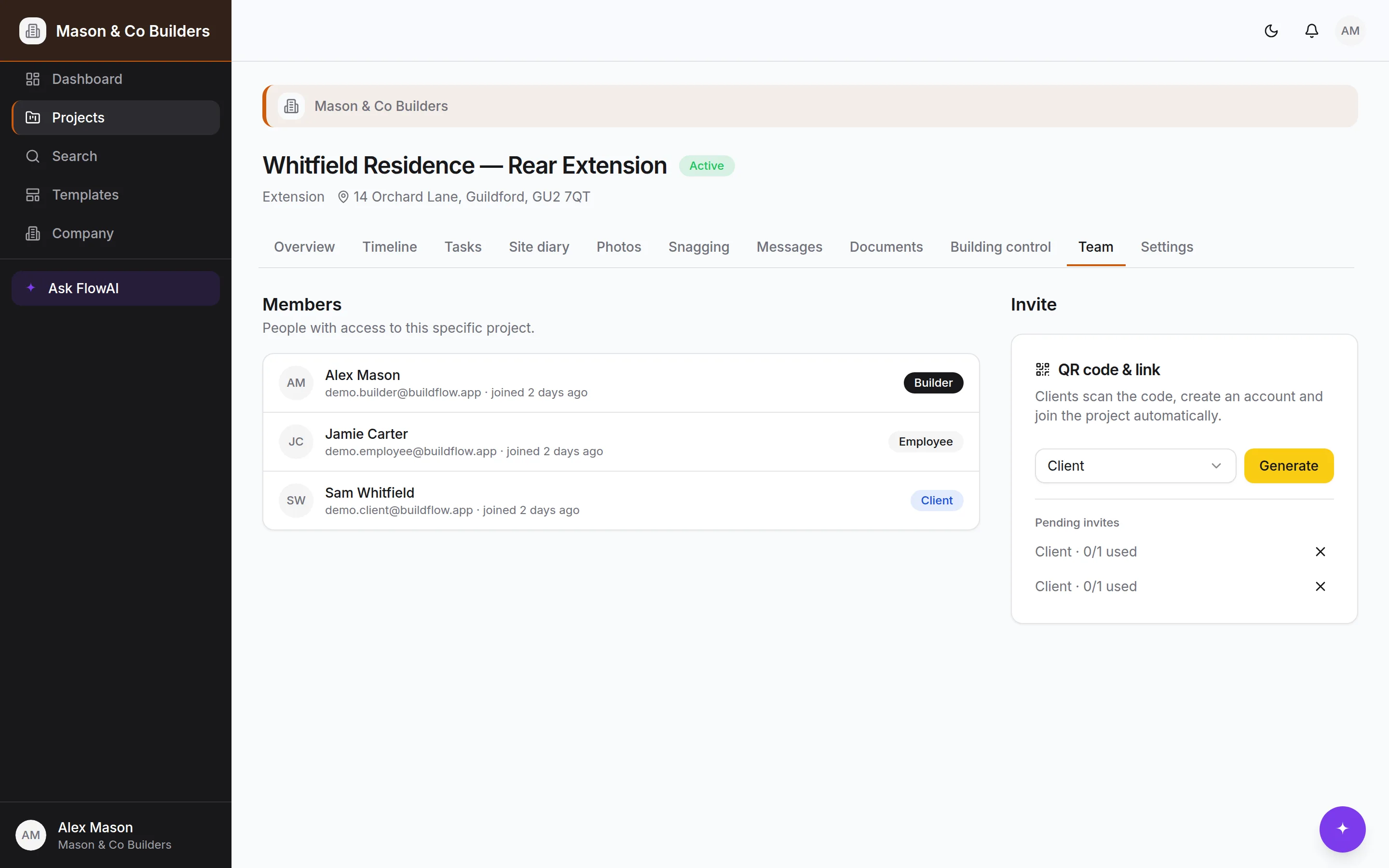
Project → Team adds an existing company member to that job, or invites a client. Project invites are per-job and expire.
Changing somebody's role
Owners and admins can change any role below their own from Company settings. Ownership itself is deliberately not a dropdown — transferring a company is a more considered thing than promoting an employee.
Seats and the plan
"Team members" for plan purposes means everyone on the company's books except you. Admins, employees and subcontractors all take a seat; counting only subcontractors would leave an obvious loophole. Clients are counted separately.
Pending invitations count as taken, so a company cannot issue more links than it has seats.
The audit trail
Database triggers record who changed what and when, with the old and new values, on every table. The log is append-only at the database level — not editable by your team, and not by us. It is the thing that answers "when did that get changed, and by whom" without anybody having to remember.